THE CANNIEPAIRT and TAYPORT FC
The Canniepairt has been Tayport Football Club’s home ground since 1975, but what do we know about the history of the Canniepairt? Let’s start with the name.
The name Canniepairt is old Scots for Cannie -nice or pleasant or exceptional – and pairt – an area of enclosed farm ground. Therefore Canniepairt literally means ‘Nice area of enclosed farm ground’
The Canniepairt is in the former Parish of Ferry Port on Craig which, from 1851 following the arrival of the North British Railway (NBR), would be known as Tayport.
The Background
Through the centuries the Canniepairt was part of the Scotscraig Estate which dates back to the 13th Century when it was owned by Sir Michael Scott, hence Scott’s Craig. Thereafter, there were various owners until, between 1740 and 1840, the estate was owned by Rev. William and Rev. Robert Dalgleish, father and son, both ministers in Ferry Port on Craig.
In the mid-19th century, the estate ownership passed from the Dalgleish family to the Maitland Dougalls, hence Dalgleish Street, Maitland Street and Dougall Street in Tayport today.
Here’s how the area looked in 1828
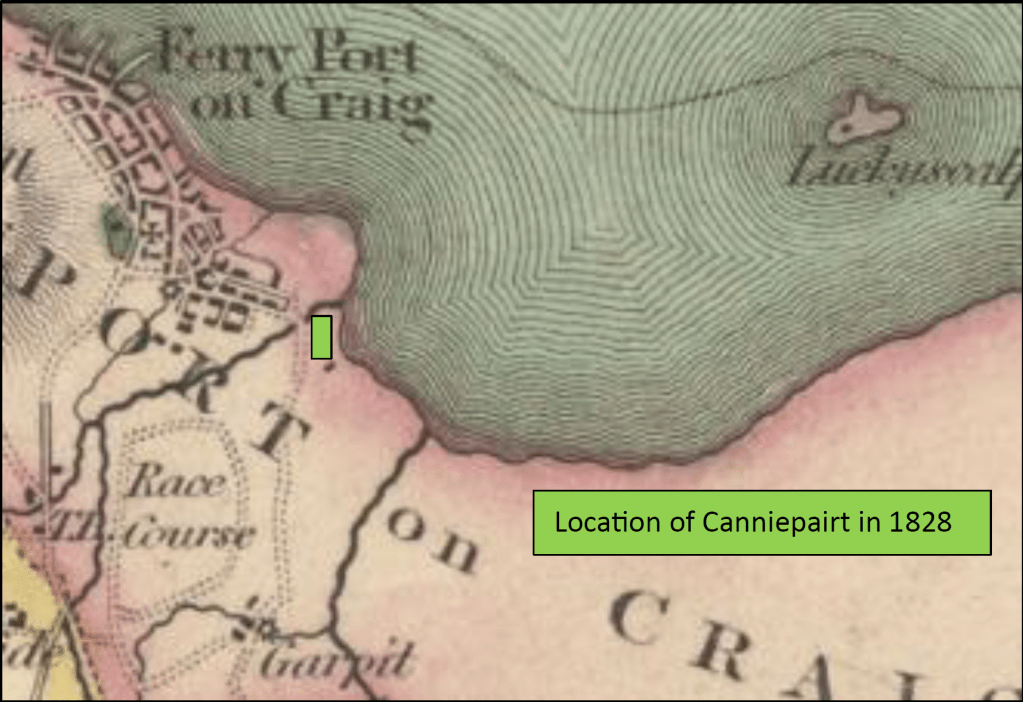
Arrival of the Railway
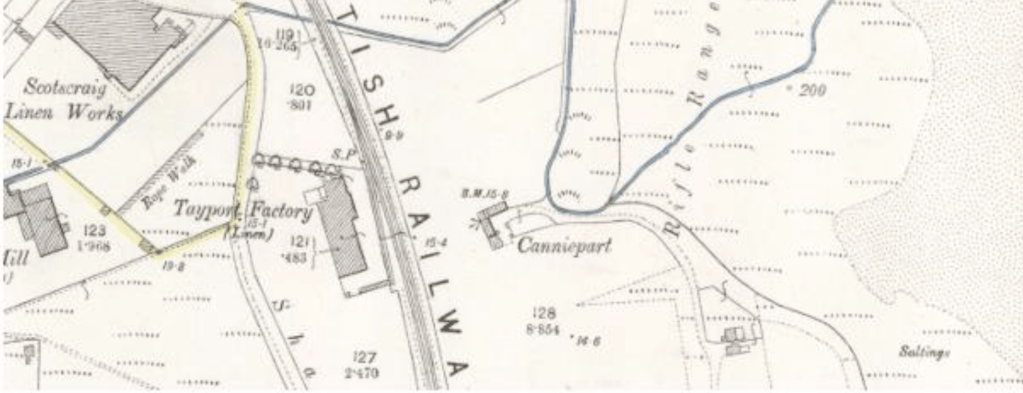
Since 1851 the NBR railway track from the south had run along the edge of the Canniepairt Farm, through what is now the spectators’ match enclosure, on its way to its terminus at Tayport harbour and the ferry across the Tay. This and the Factory Burn effectively restricted access to Canniepairt to what is now Links Road North and the Mill Bridge which crossed the railway and linked Shanwell Road to Shanwell Road South.
The 1894 image below shows how the new Railway cut off south and west access to Canniepairt.
For roughly 50 years, until 1874, David and Agnes Melville farmed the Canniepairt’s 6 acres, on lease from Scotscraig Estate. In 1851, the Melvilles’ daughter Catherine, her husband David Ritchie and two young daughters were also resident on the farm before relocating to Montrose. Mrs Melville was 83 when she died at Canniepairt in 1874. For her husband David, also aged 83, continuing with the farm was clearly going to be a struggle.
Following the death of Mrs Melville, it became common knowledge that the farm tenancy would soon be available with a number of parties showing interest. One such party was Robert and Jessie Robertson who wrote the following letter to their son John who lived in Duloch, Inverkeithing.
March 2 1874
My Dear Son & Daughter
I now write you a few lines in answer to your awaited letter. We were thinking there was surely something wrong with you. We were dreaming strange dreams about you. We were so glad to see you were both well.
Dear son and daughter I have news to write which will make you wonder. I believe your father has got a farm of 6 acres. It belongs to Capt. Dougal [sic]. The man that is in it has had it above 40 years.
His wife died last week at the age of 83 so he has given it up as he would not be biden leave it all his life. So, after Robbie heard it was to let, he thought he would like it and went and asked it from the Capt. but he laughed and said to him it was not a place for him, it was just for an old man so he asked if he would give it to his father. He said he had no objections but other three people were wanting it so he told your father on Saturday to go and look over it and give him ideas what he thought he would give for it so he offered £8.15. The other offers were a good deal higher but he preferred your father, so he told him today when it was settled, he would never bid him flit as long as he lived if he paid his rent and behaved himself. Your father bids me to tell you that if you’re inclined to come, the house would hold us both and you would find plenty of work hereabout. It is close on the sea at the east end of the Ferry [Ferry Port on Craig]. We think we could be very comfortable, the one could help the other. Your father would think well that you would come. He thinks you or him could take a day or two when you liked and him and you could improve the land as the people were very old and he has not been able to do too much to it for a while back. If we could muster a cow about grass time. There is great demand for milk in the Ferry. The old folk had a cow and a beast and we might bring up young pigs for sale but I am perhaps going too far. We must say if the Lord will we will, we must do this or that we must trust in him for a blessing on all our labour.
I must tell you the truth, I have never seen my way very clear about it, I have always looked on the dark side thinking we would not manage to get everything we would need and manage to pay the rent. It is not a great deal more than we pay for this house with no land. There is a barn, byre, cruive and they are all to be repaired and the house made comfortable.
We are close on the mills and factories. We can’t tell if the old man will leave before his term or not. He has houses of his own in the Ferry to go to.
I must tell you the name of it now. It is called the Cannie Part [sic]. You would maybe see the name amongst the list of deaths in the papers on Saturday We are both in moderate good health. Thank God for his tender mercies toward us. I will now conclude for I daresay you will be tired of this long scribble.
Your ever loving parents,
R.J.Robertson
And then in April another letter…
April 1st 1874
My Dear Son & Daughter
I now write you an answer to your long expected letter which we received today. We are glad to know you are both well… leaves us all here at present thanks to our Heavenly Father for all the things he is ever bestowing upon us. We cannot tell how glad we are you are willing to come beside us. Your father thinks we will be able to work it together. It is all laboured but a small bit in grass. Your father was down seeing about some grass seed sowing. He will not get so much sown as he was intending as the man [David Melville] had rye sown a while ago. It is a light sandy soil but it carries all sorts of grain but wheat, as it causes nothing but trouble. The man is to sow barley in it but has not been
done as they are very old people. The wife used to do most of the work. They have kept 2 cows and a stirk on it. There is about an acre of sea grass belongs to it never tilled and a right to the common besides. There is some dredging stuff comes out of the harbour. Your father was speaking about it to the Capt. the day to get some of it to put on the land. Some of the other people close beside it has got it and tills greatly where it was put on. We have a great chance to get it for the Capt. is to speak for it. It costs nothing but the trouble pulling it as they are glad to put it out of their way.
Your father was never in the house but it seems to be good enough as it is similar to Mayfield but a great deal bigger. It seems to have a garret the same so we think it will hold us well enough. Work is ripe, older men than your father is getting 18s a week.
The railway road is the west march and the sea is the east. Robert has got some prize chickens for it. He has got the eggs all the way from England, 24s the dozen, 2s for the carriage. Another man got the half and only three of Robert’s half dozen came out. He has got another half dozen from Berwick on Tweed sent last night 6s 6d.
Your loving parents R & J Robertson. Write soon son
And in the autumn of that year… letter sent by his parents to Mr John Robertson, Duloch, Inverkeithing
28 October 1874
My Dear Son & Daughter,
We received your letter and are happy to hear you are both well as this leaves us all here at present. Your father went to the Cannie part [sic] last night to see if the man was to leave before the term so he told him he is to leave on Monday first so we will remove on Friday next week if all is well. He says the house is not so bad. The room end has been papered and has a good flag floor. There is two beds on each end only. The ceiling is just the joists but they are whitewashed. The end he is staying in has a flag floor, two only it looked dirtier but it seems dry like. It was just in candlelight if other things do, the house will do he thinks. A roomy byre with three stalls and the barn has a dead floor. If we have God’s blessing all will be well.
Your father bids me say that he will be ready any time after the end of next week to look for your things at the station. We will look for a letter from you to let us know how are your arrangements. We are glad that your father has got a place. He will be much better for his body and his mind will be easier.
I will now conclude hoping to see you all soon if we are all spared.
Your ever loving parents,
R&J Robertson
A Thriving Farm
John Robertson, a platelayer on the railway, and his wife, Agnes, two sons and two daughters, duly moved in to the Canniepairt to join his parents. The farm thrived and the extended family became stalwarts in the community over the next 58 years.
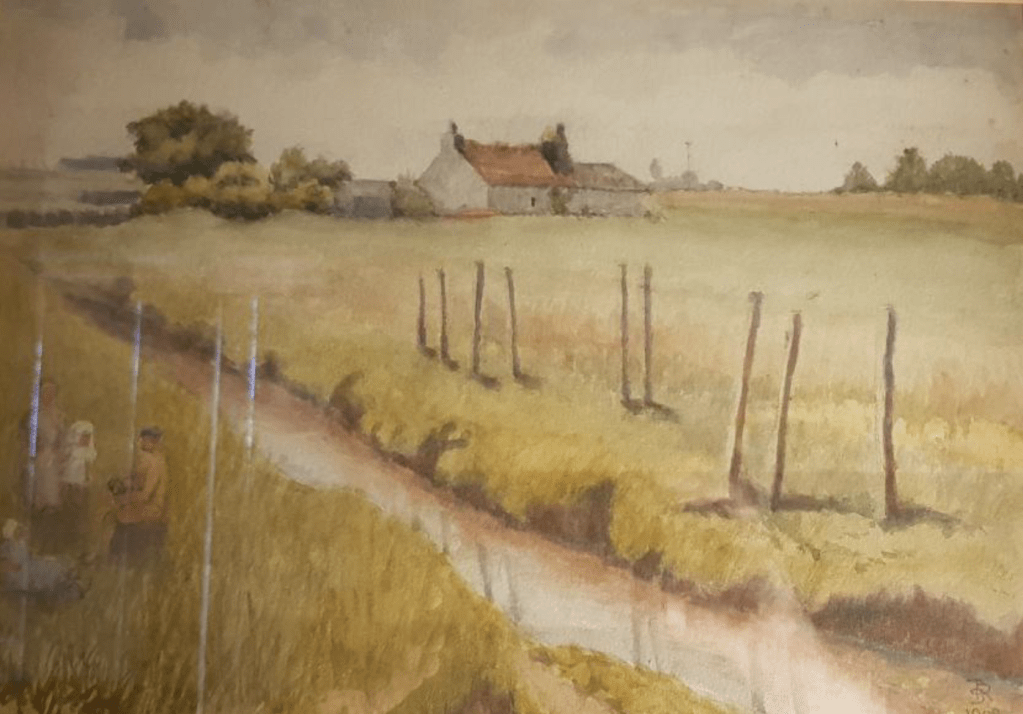
The Canniepairt farmhouse painted by Jessie Robertson
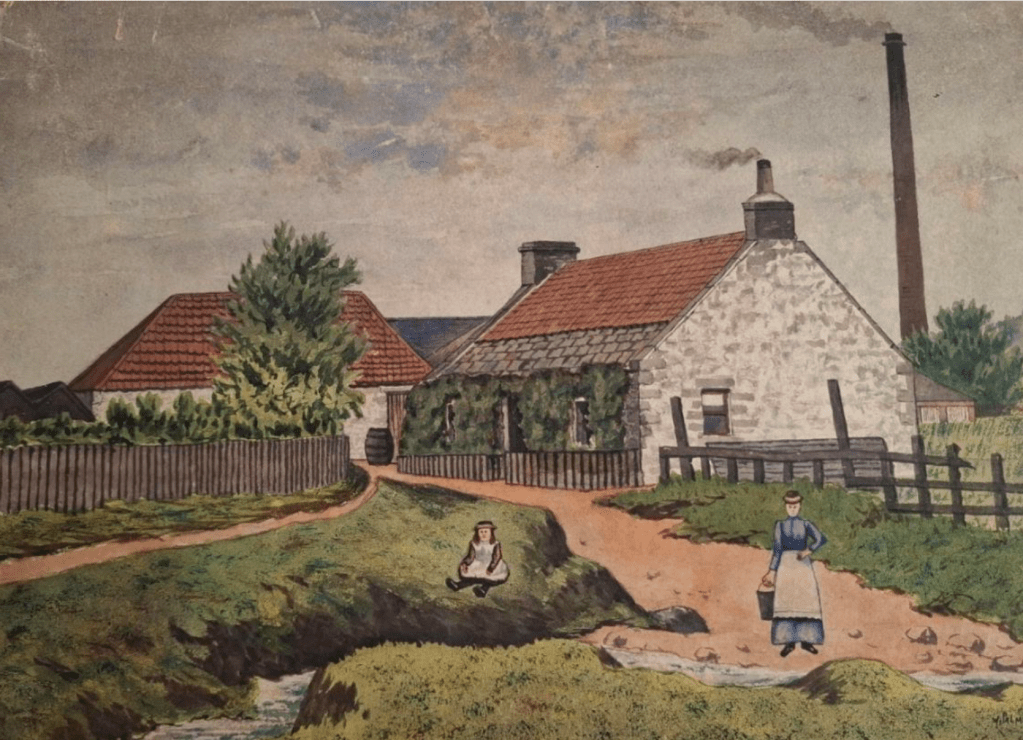
1893 painting of the Canniepairt farmhouse and steading by V.Palmer
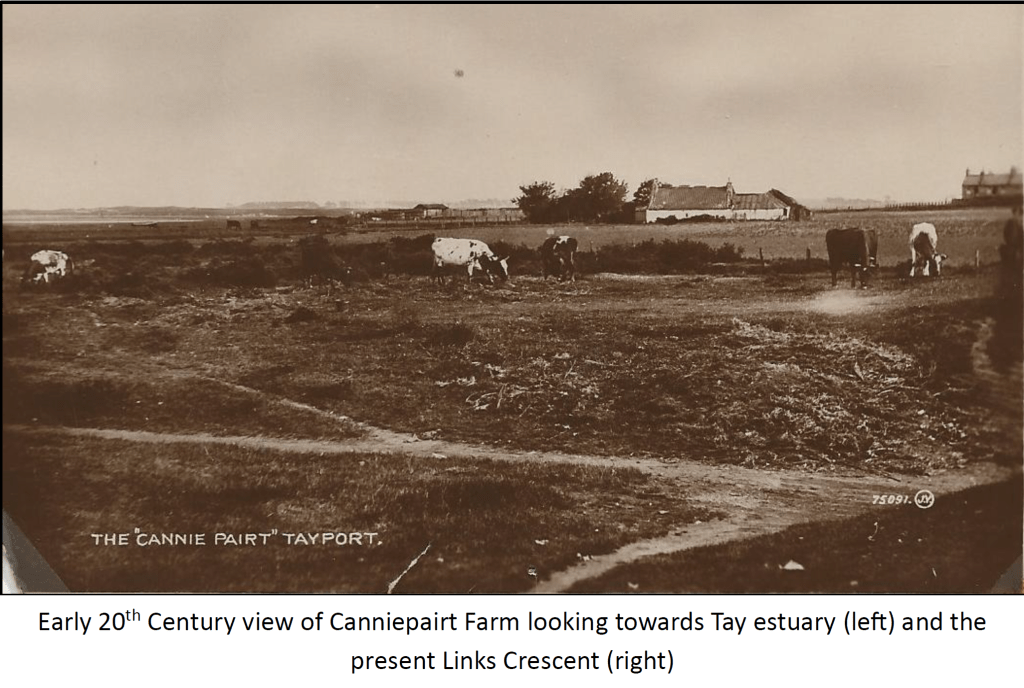
The parents, Robert & Jessie Robertson, died around the turn of the century leaving John and Agnes to continue the tenancy. John was pre-deceased by Agnes and when he passed away in 1917, daughter Jessie became the tenant with her husband Francis Oswald. And that’s when the Oswald name first had a Canniepairt connection.
Following the death of William Maitland Dougall in 1916, the decision was made to sell the Scotscraig family estate, which pretty much covered the entire parish of Ferry-Port-On-Craig [Tayport].
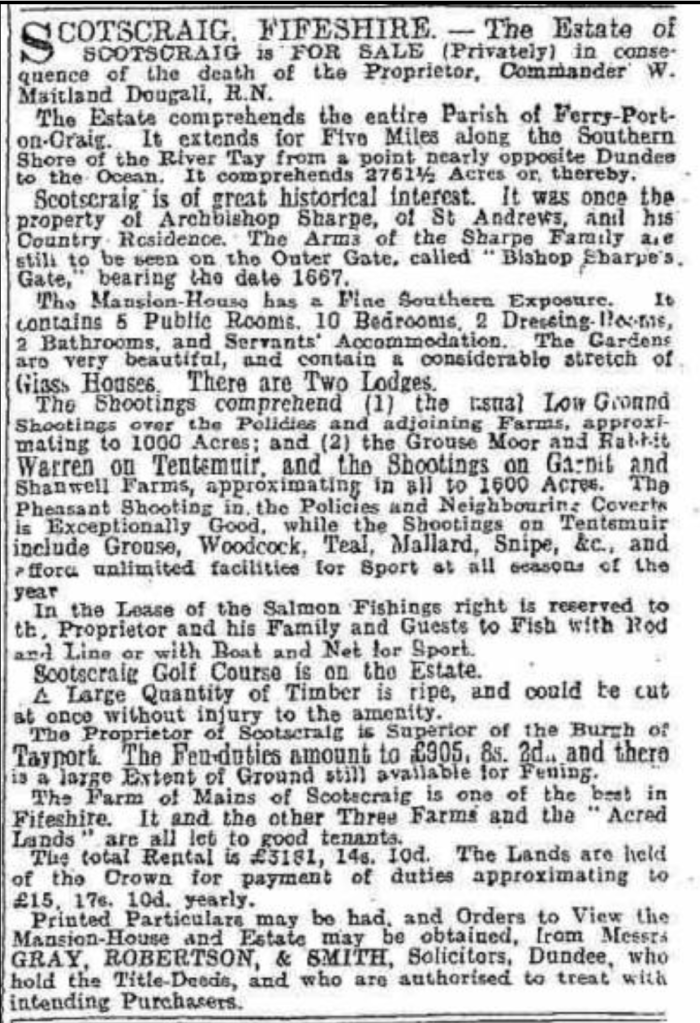
As well as the Canniepairt farm, the estate included other farms, the golf course, the mansion house and access to the waterfront. The Estate was advertised for sale in June 1917 in newspapers up and down the country. Below is The Scotsman advert. However, the buyer was found much closer to home when it was sold to Dundee Council for £52,000 – around £4.5 million in 2026 values.
Dundee makes a bid for Tayport!
Dundee Council had voted 21 to 2 to buy up Tayport…or at least a good part of it. Their plan was to take advantage of the railway and its south Tay coastline location to develop Tayport and the Scotscraig Estate for heavy industry, particularly for more shipbuilding. James Thomson, renowned Dundee City Council Engineer, had suggested that if the waterfront and area around that railway line were improved, the land could be used for shipbuilding as well as ship repair, engineering, factories, workshops and warehouses.
A Planned Takeover
The same year Dundee Council set up a sub-committee to investigate whether to extend its city boundaries to include Tayport and the Scotscraig Estate. On 3rd March 1919, after discussions with Tayport Town Council, it was decided that they did not have the mandate to decide whether Tayport could be absorbed into Dundee [phew… a bit of a break there!]
Over that summer, Dundee’s Town Clerk prepared a memorandum for distribution in Tayport. It outlined why Dundee wanted to amalgamate with Tayport and what were the perceived benefits for the townspeople. This included freezing rates [Council Tax] for Tayport at the lower price than Dundee. Gas and electricity would also be supplied to Tayport at the cheaper Dundee rates. It also pointed out benefits of access to better health care and child welfare, as well as access to charitable funds based in Dundee. Dundee also promised that developed land would bring more jobs, and that they would develop more leisure facilities. The amalgamation would also increase the railway facilities. In addition, Tayport would get 3 representatives on the council. A meeting was arranged for October later that year in order to give Dundee Council the opportunity to discuss their plans with the residents of Tayport.
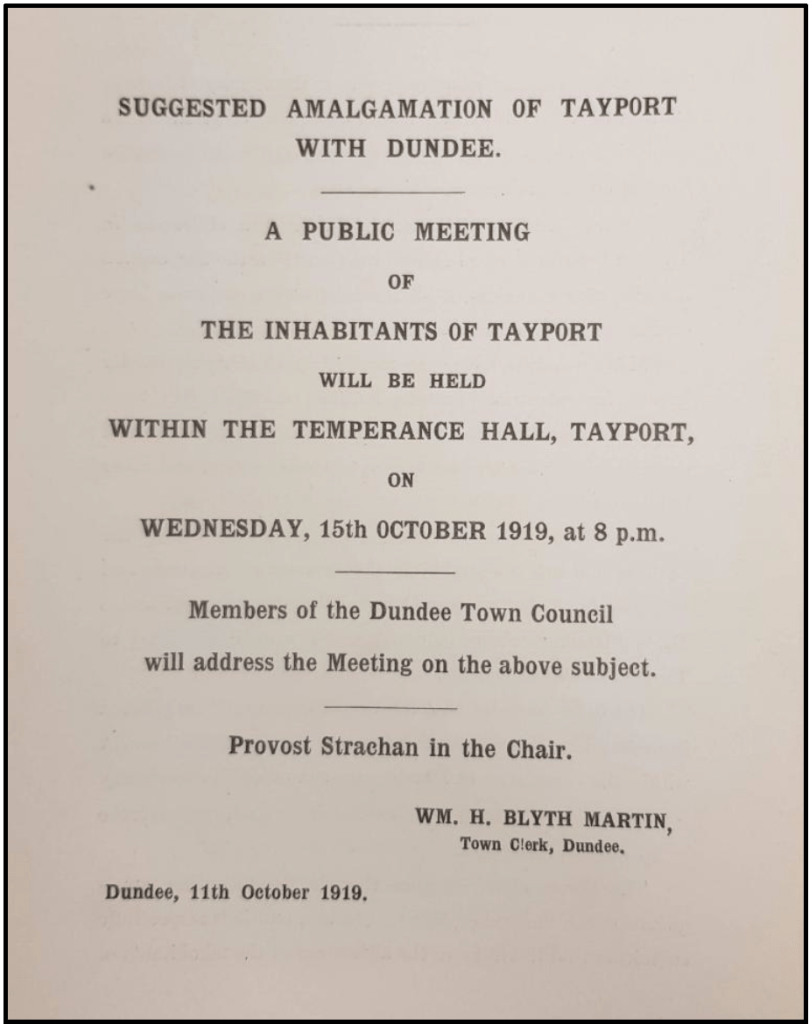
A pamphlet was circulated for the meeting which was to be held on Wednesday 15th October 1919. It was proposed that a postcard plebiscite (below) take place but the timeline was too short – only 5 days – so Tayport Council decided the vote would be held after the forthcoming council elections.
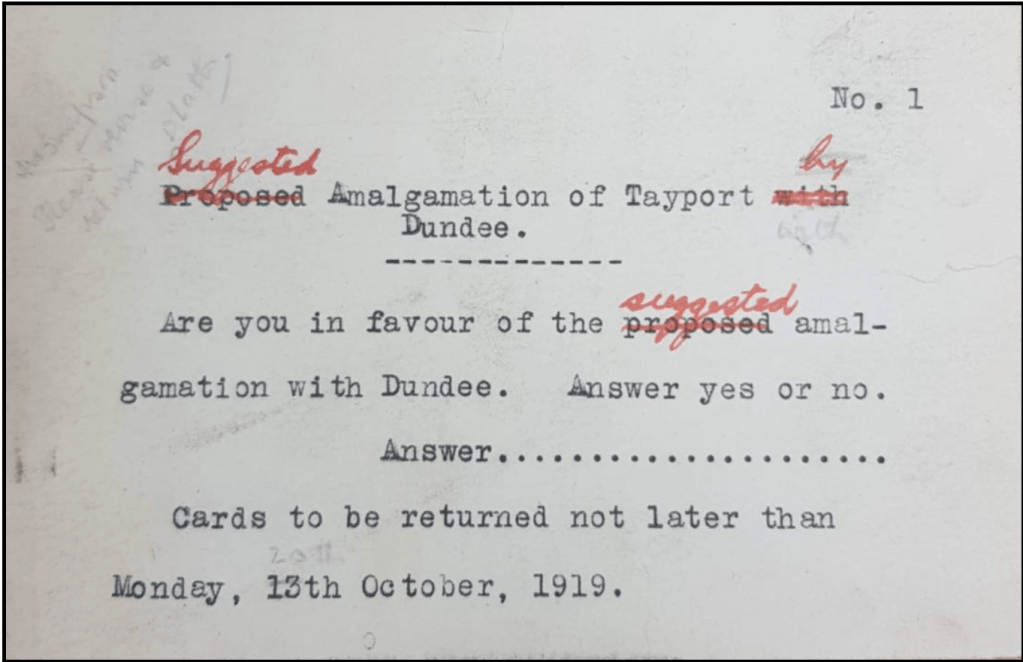
By December 1919 though, it seems that Dundee had changed its mind and informed Tayport Town Council that the vote would not go ahead. The reasons for this are unclear.
Perhaps Dundee felt that they already had enough on their plate and didn’t feel they would get the support they needed in Dundee. So, Tayport remained in Fife and Dundee didn’t get to stretch across the water.
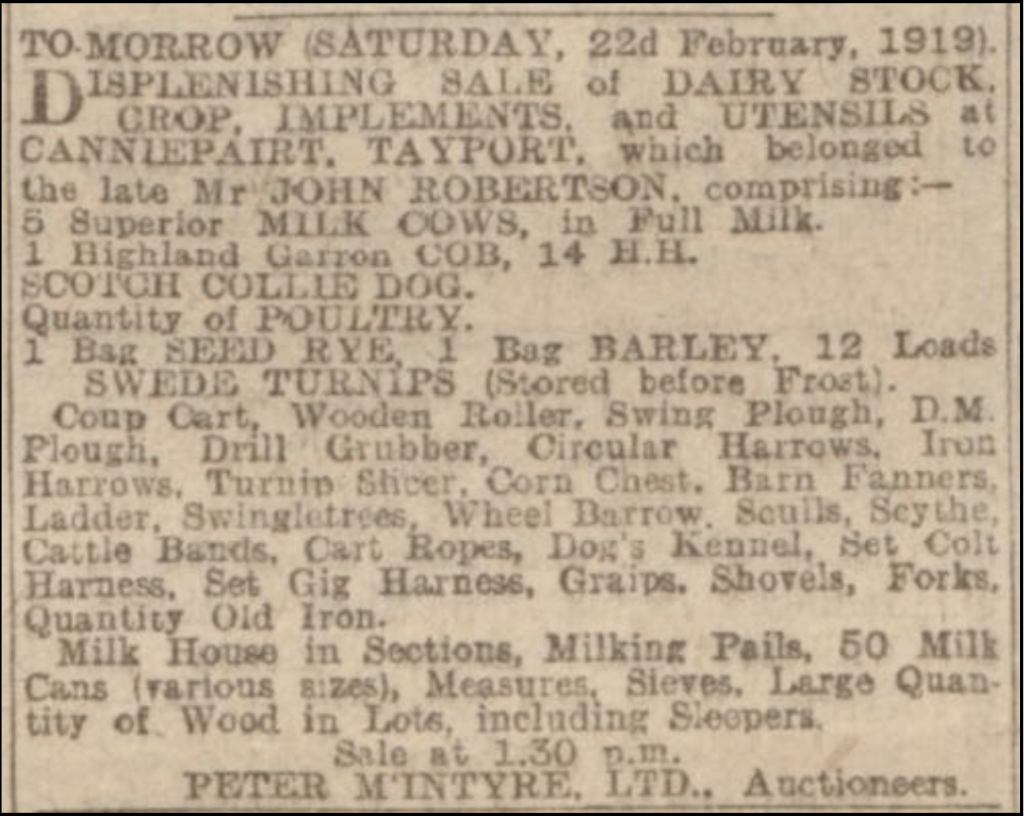
Over future years, Dundee Council, having realised their folly of trying to invade Tayport, would sell off parts of the now unwanted Scotscraig Estate. However, the Canniepairt was a part they wished to retain. It was during this period that signalled the end of the Canniepairt as a farm. Francis and Jessie Oswald (née Robertson), had taken over the tenancy from Jessie’s father but they weren’t farmers and the decision was made in 1919 to sell off the farm’s contents. The Oswalds were now the sole tenants at Canniepairt.
In 1933, however, Dundee Council would not agree to extend their lease nor sell to the tenants, advising that they had plans to develop the area for industrial use, thus ending a 58 years family connection with the farm. (see letter below)
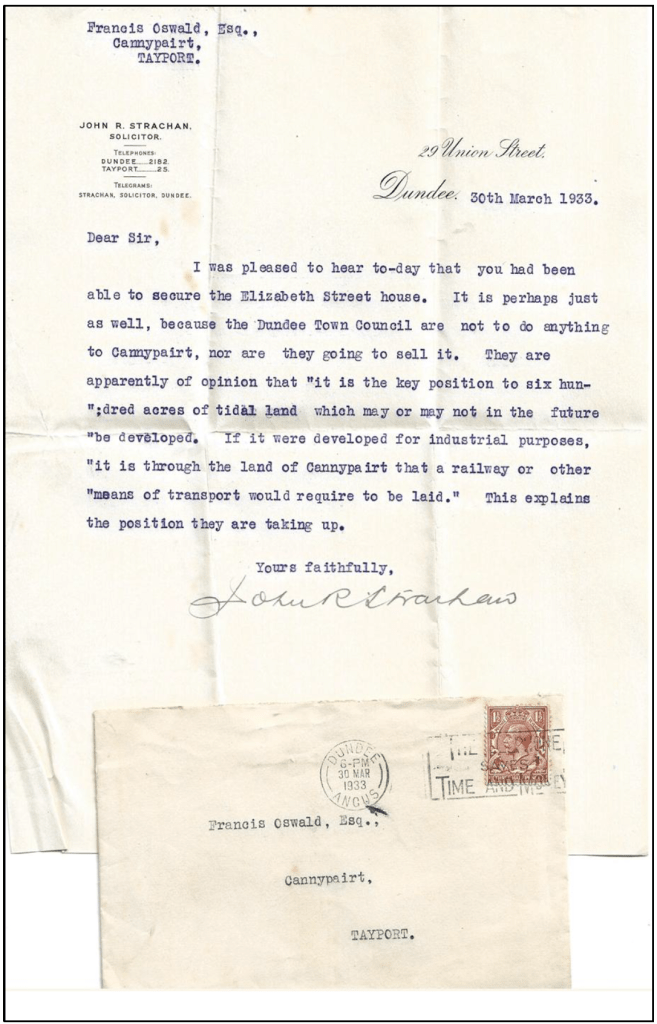
Dundee Council Turns Down Tayport Town Council Offer to Buy Back the Canniepairt
Industrial development didn’t happen and in 1941 Tayport Town Council tried to buy Canniepairt back from Dundee Council, offering £250. Dundee demanded £300 ’or there would be no deal’. Dundee’s City Engineer commented ‘it was last used as a piggery and had since been lying derelict. Partly submerged at high tides, it was useful only as a rubbish dump’. Dundee Council’s Treasurer Caldwell chipped in, saying ‘After this war, we’ll be annexing Tayport anyway, so it doesn’t matter’.
That deal fell through but eventually the ground was acquired by Tayport Town Council.
In the ensuing 25 years or so there were various proposals, all of which came to nothing and the ground was left unused and overgrown until 1970 when things would all change.
POLEX 70 (Pipeline Over Land EXercise 1970)
Polex 70 was a huge and complex bulk fuel supply exercise which involved the RAF, Army Engineers and Royal Navy laying a pipeline from the Royal Fleet Auxiliary tanker ‘Green Rover’, berthed in the Tay off Tayport, to RAF Leuchars via the former railway track. This pipeline would bring in some 300,000 gallons of aviation fuel for on-shore storage tanks. To build this light weight rapid construction facility for storage, the Engineers required a suitable location and the Canniepairt ticked all the boxes.
In the autumn of 1970, in preparation for the exercise, 1,000 tonnes of stores etc were brought in by road and rail, and 450 servicemen were encamped in Tayport as the ship-to- shore-to-RAF Leuchars exercise got underway.
Although an earlier plan to base this exercise at Elie didn’t find favour with the Elie Town Council, it did with Tayport Town Council and in particular, Burgh Surveyor Andrew Peter, who was aware of how this could be of benefit to the town. The Army’s bulldozers and other earthmoving equipment would flatten the overgrown area of scrubland which Canniepairt had become and which was deemed to be of little use. On completion of the exercise, expected to last around a month, the arrangement would see the Army leave the area clear and level.
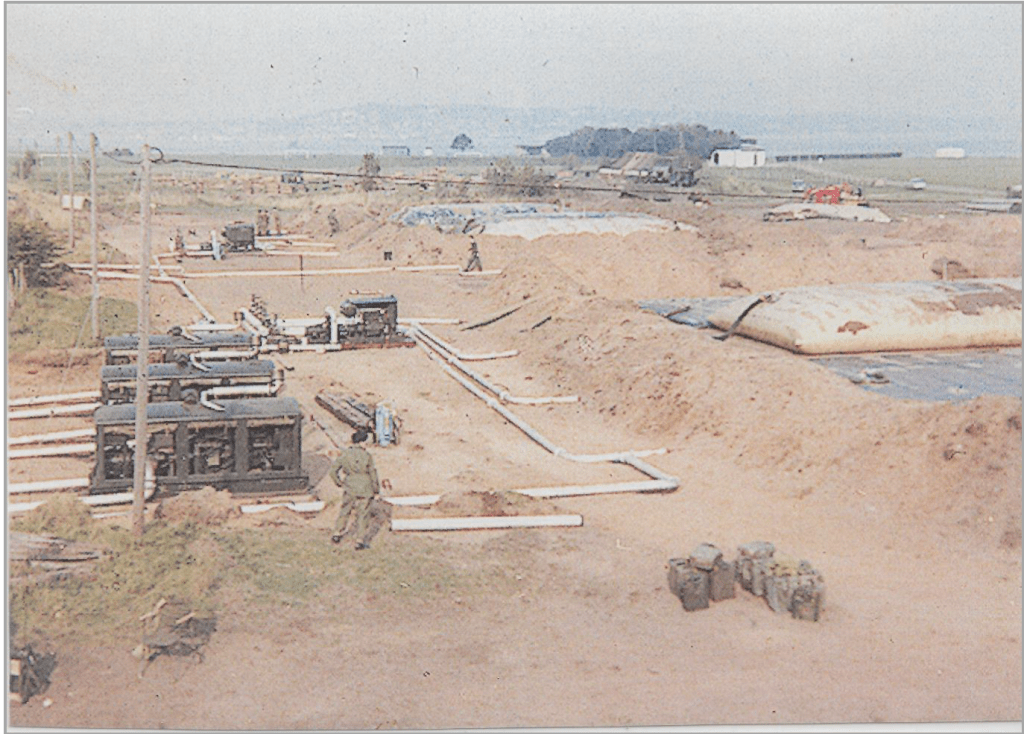
POLEX 70 underway on the Canniepairt
The photograph above shows the exercise well underway. In the background we can see the East Common and Tayport FC’s changing hut on the Promenade and the outline of Broughty Ferry in the far distance. On closer examination, the goalposts on the Common are visible as are the shelter and public conveniences at the east end of the Promenade.
The ‘New’ Canniepairt takes shape
Tayport FC’s football pitch was on East Common where it had been located for many, many years. The club’s changing accommodation was owned by the Town Council owned wooden hut where the facilities within were limited to gas lighting and a single sink with cold water.
From March 1971 the Football Club, looking to the future, had been seeking to improve its changing facilities and was investigating the possibility of grant aid in order to build new accommodation. This proposal was complicated by the fact that the East Common was designated common ground.
In November 1973 Albert Oswald snr. reported to a committee meeting of an informal discussion he had with Burgh Surveyor Andrew Peter. Mr Peter had suggested that the Town Council would probably look more favourably at a new pavilion and pitch on the Canniepairt. The Committee decided to pursue this avenue and plans were drawn up by Tayport FC committee member Ian Mathers. Cupar firm RS Wilson’s tender of £11,500 [£90,500 in 2026] was accepted with Ian Mathers supervising construction. [He would later have a major role in the construction of the new Overgate in Dundee and the OVO Hydro in Glasgow].
The cost was met through a Scottish Sports Council grant (£5,500), a Tayport Town Council grant (£2,500) and the remainder by Tayport FC. Tayport FC did not have the funds at this stage but negotiated a bank loan with Tayport Youth Development Committee acted as guarantors whilst the football club embarked on a successful fundraising drive to raise their +25%.
Plans were submitted in September 1974 and Provost Jim Pow kicked off the construction by digging the first turf in January 1975.
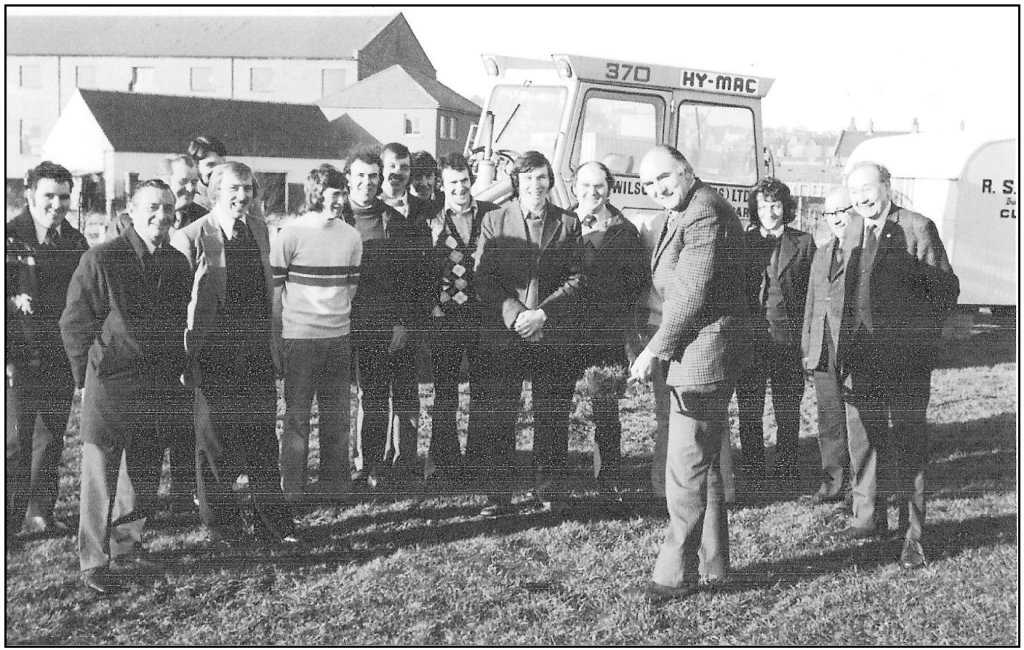
January 1975 and the first sod is cut on the Canniepairt, the site of the club’s new pavilion, by Tayport’s Provost, J.B.Pow.
Pictured from left are Committee members Fred Bremner, Davie Hughes, RS Wilson (Contractor), Doug Henderson, Abby Oswald, Stewart Ritchie, Ernie Simpson, Alastair Oswald, Jim Lindsay, Alex Ritchie, Ian Mathers, Andy Robertson, Provost Pow, Iain Cougan, Albert Oswald Snr and Burgh Surveyor Andrew Peter.
Note the now demolished Scott & Fyfe factory and offices in the background.
Although the pavilion construction was soon complete, it took the best part of three years and significant funding to lay the pitch. 700 tonnes of top soil was acquired from Elmwood College. Henderson Bros, Paterson Bros and Bett Brothers were engaged to haul the soil and then grade the top soil. A Job Creation squad also played a role by removing stones.
In 1977 and 1978 local farmer George Finlay prepared the final surface by rotovating and rolling and, along with Messrs Sutherland & Watt, carried out the seeding.
The fundraising continued as the years rolled on. 1979, a dressing room extension; 1988, a 1st floor extension; 1990, a pitch side barrier; 1992, floodlit training pitch established; 1994, a standing enclosure built; 1997, extension to provide public toilet and refreshment facilities; More recently, in the 2000s, further extensions to provide additional changing, administration and hospitality facilities.
During these 50 years on the Canniepairt the development and fundraising has been hugely supported by players, committee, friends and local businesses who have all assisted in turning the Canniepairt from what was a piece of abandoned land in 1975 to the facility which the club and community can enjoy today.
Within 20 years of moving to the Canniepairt, the club had reached the first of their six Scottish Junior Cups Finals, giving the locals and many others, unprecedented football joy whilst at the same time putting the wee town of Tayport firmly on the map.
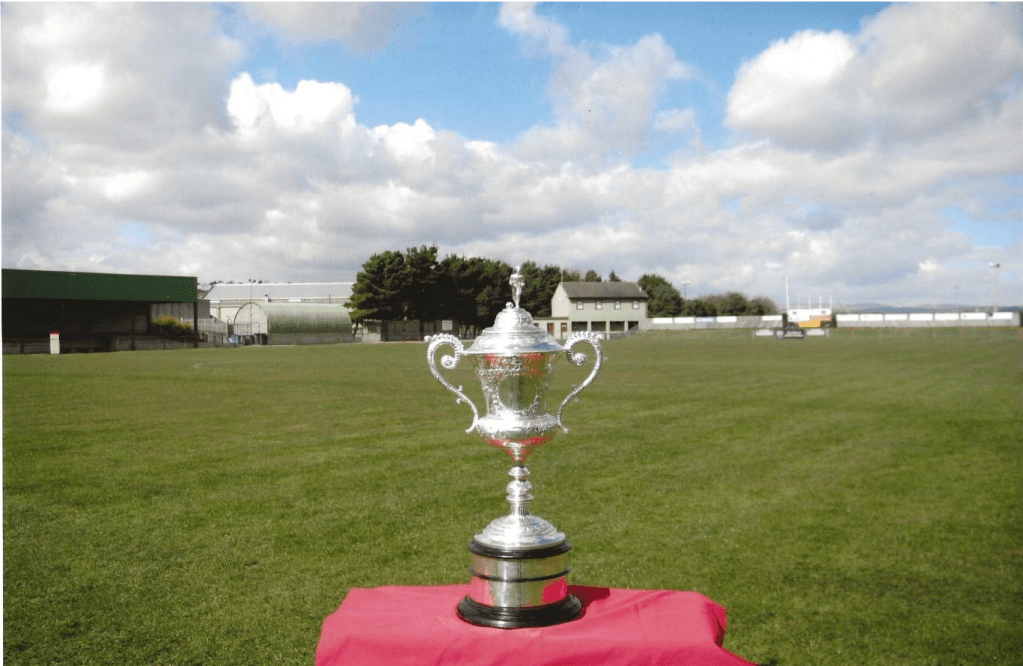
The Scottish Junior Cup was first at the Canniepairt in 1996, returning in 2003 and 2005
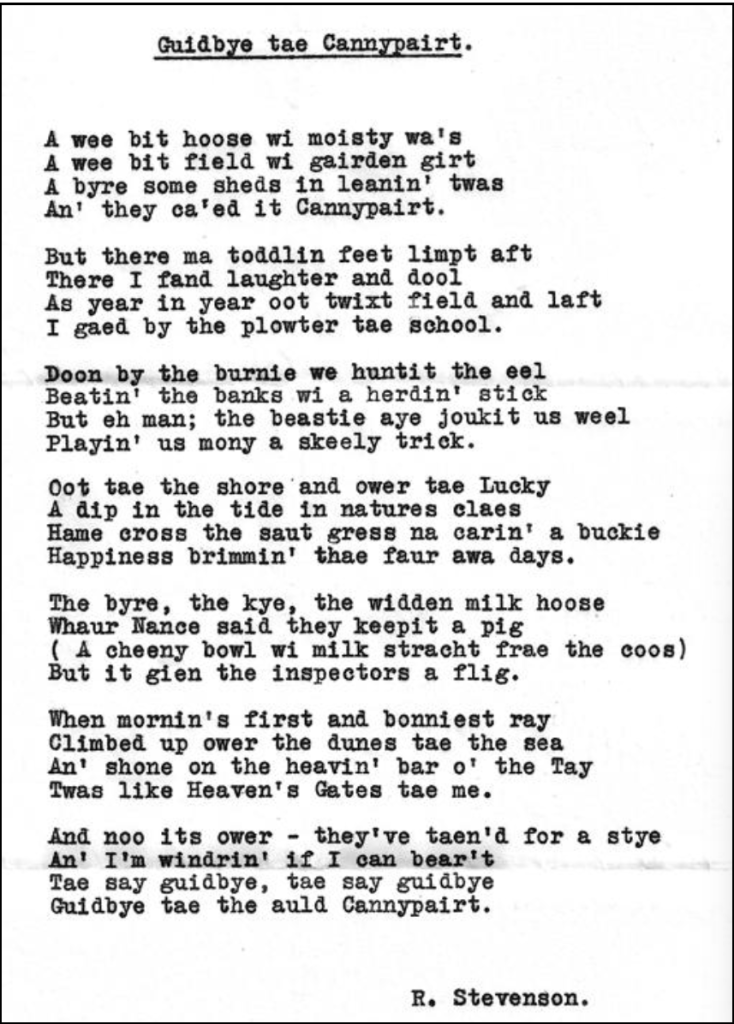
An ode written to bemoan the end of the Canniepairt as a farm
.

